

Economy Sandwich Panel
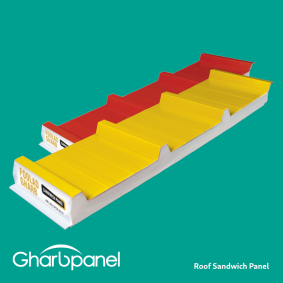
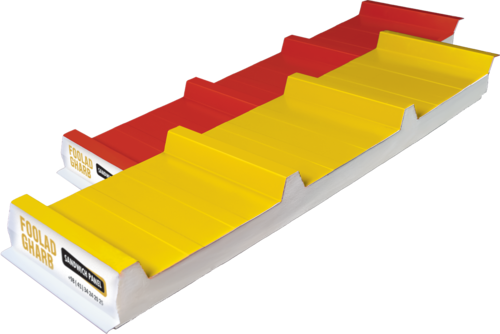
Economy Polyurethane (PU) Roof Sandwich Panel
Suitable for covering warehouses, industrial sheds, and poultry farms
This single-sided sandwich panel features a 2 cm thick polyurethane insulation core, with a pre-painted galvanized steel top sheet and a waterproof paper bottom sheet. By using a 2 cm PU core and replacing the bottom sheet with waterproof paper, this panel offers an economical solution while maintaining the main benefits of a sandwich panel. As a result, it serves as a suitable alternative to traditional corrugated roofing sheets. Installation is also faster and easier compared to corrugated roofing with additional insulation layers like fiberglass.
Single-sided PU roof panels are ideal for applications such as warehouses where thermal insulation is not a critical requirement.
Gharb Panel Industrial Group
GharbPanel officially began operations in 2002 with the production of polystyrene sandwich panels in the Shahid Salimi Industrial Town of Tabriz. Today, leveraging a state-of-the-art production line, advanced loading and unloading systems, a quality control laboratory, and a skilled workforce, the company has expanded its activities to produce polyurethane (PU) sandwich panels. GharbPanel’s current annual production capacity is one million square meters of sandwich panels and over 19,000 tons of various formed sheets, with development plans aiming to increase this to 2.5 million square meters.
Through the establishment of a research and development team, GharbPanel has enhanced the quality of its products and introduced innovative solutions to meet a wider range of customer needs. The company strives to offer products that are not only economical but also better suited to different climates and applications.
Dimensions of Single-Sided Sandwich Panels
The dimensions of a single-sided sandwich panel include its width, length, and insulation thickness. The panel width is generally produced according to a standard size and depends on the profile type (roof or wall), the number of corrugation steps, and the required overlap. The width can be adjusted by considering the overlap, and the effective width is slightly less than the total panel width due to this overlap. A recommended overlap of 15 cm is suggested. The insulation thickness for this panel is 2 cm.
There are virtually no restrictions on the panel length during production. Panels can be manufactured in large lengths and then cut to sizes ranging from 2 to 15 meters according to customer needs and transportation requirements. The main limitation for panel length is the maximum allowable transport length on roads by trailer.

| عرض ورق خام | ۱۲۰۰ mm |
|---|---|
| عرض مفید | ۱۰۰۰ mm |
| طول | ۲ - ۱۳ m |
| تعداد گام | ۴ |
| ضخامت عایق | ۲ - ۳ - ۴ - ۵ cm |
| ضخامت ورق رو | ۰٫۴۰ - ۰٫۵۰ mm |
| نوع ورق رو | ورق گالوانیزه، رنگی، آلوزینک، آلومینیوم |
| نوع ورق زیر | کاغذ فویلدار |
| نوع عایق | پلی اورتان PU |
Features of Single-Sided PU Sandwich Panels
-

Thermal Insulation -

Durability -

Waterproof -

Sound insulation -

Fire resistant -

Quick and easy installation
Applications of Single-Sided Polyurethane (PU) Sandwich Panels
Thanks to their unique characteristics, single-sided sandwich panels have versatile applications. The choice of panel should depend on the intended use, specific requirements, climate conditions, and budget. Due to its affordable price, this type of panel is an economical option for roofing in livestock and poultry facilities, such as poultry farms. Using polyurethane not only meets the construction standards for such buildings but also provides a cost-effective solution.
Call for Advice
+98 912 017 1242Key Factors in Selecting Sandwich Panels
The specifications of sandwich panels depend on several important factors that should be determined by a qualified engineer based on the structure’s application, environmental conditions, and project requirements. These factors include:
- Profile Type: Roof or wall panels.
- Sheet Material: The outer and inner sheets may be galvanized steel, aluzinc, or aluminum. In some cases, the inner layer can be replaced with waterproof foil-coated paper.
- Sheet Thickness: Thicker sheets provide greater durability. Commonly, the inner sheet is chosen thinner than the outer one.
- Sheet Color: The inner sheet, which serves as the interior ceiling, is usually white, while roof sheets are often available in blue, red, or orange.
- Insulation Type: Options include polystyrene, which is more economical, and polyurethane, which offers better thermal performance and fire resistance.
- Insulation Thickness: Thicker insulation improves resistance against heat and cold.
- Insulation Density: The density of the insulation is selected according to the intended application.
- Sheet Width: Each profile type supports a specific sheet width, but after rolling, the final panel width will be slightly reduced. Additionally, due to panel overlap, the required panel area should be calculated to be larger than the exact building dimensions.